Attunement
Meeting people where they are — sensorially, emotionally and culturally — before attempting to lead or facilitate.
Practitioner Framework
ARTI names the four capacities a practitioner draws on when the room is unfamiliar, the stakes are real and there is no script for what comes next.
Attunement · Regulation · Temporality · Improvisation
ARTI describes what it takes to stay present enough to know.
The framework belongs to intercultural facilitation across contexts: a concert hall, a classroom, a ship at sea, a residency, a workshop or a boardroom.
The Four Capacities
Meeting people where they are — sensorially, emotionally and culturally — before attempting to lead or facilitate.
Maintaining internal coherence under conditions of cultural difference, ambiguity and relational complexity.
Reading timing, rhythm and pace as instruments of relational design: when to speak, when to wait, when to move.
Responding creatively and intelligently to what the moment presents, with enough discipline to meet the room as it is.
Origin
ARTI was developed by Vilma Esquivel through her MA research at Soka University, Tokyo, drawing on music therapy, embodied mediation and years of intercultural practice.
Her research describes the musically formed mediator as a practitioner capable of orchestrating relational possibility through capacities cultivated by artistic discipline.
See ARTI's academic framingThe musically formed mediator does not merely facilitate dialogue but orchestrates relational possibility.
ARTI in Practice
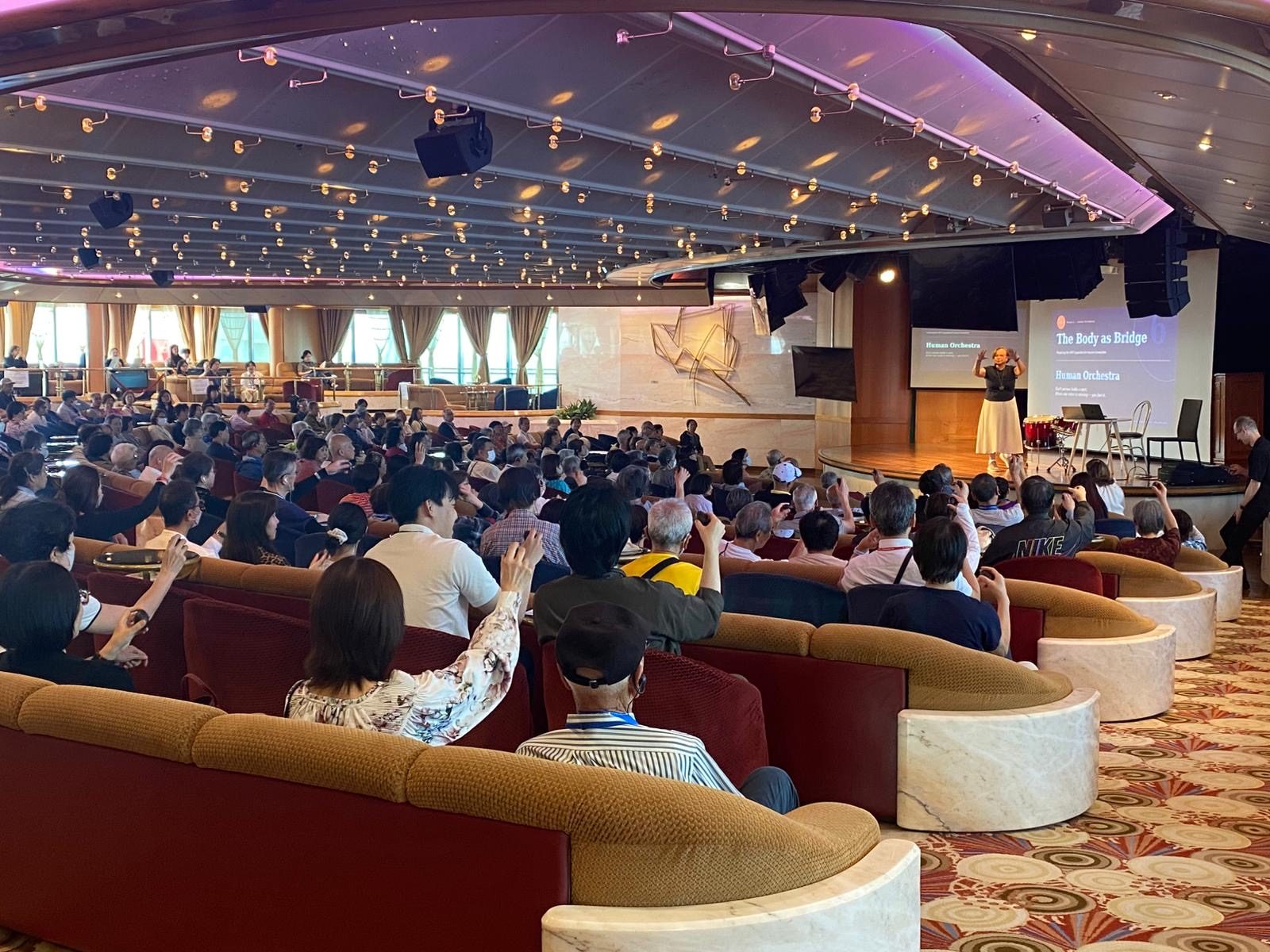
The Body as Bridge Vilma's embodied workshop aboard Peace Boat drew directly on ARTI.
Intercultural facilitation ARTI informs how Bridges approaches rooms where people from different cultural worlds need to find enough common ground to work together.
Transversal practice ARTI applies across culture, education and communication because it describes what the practitioner brings — independent of the specific context they are entering.
Connect